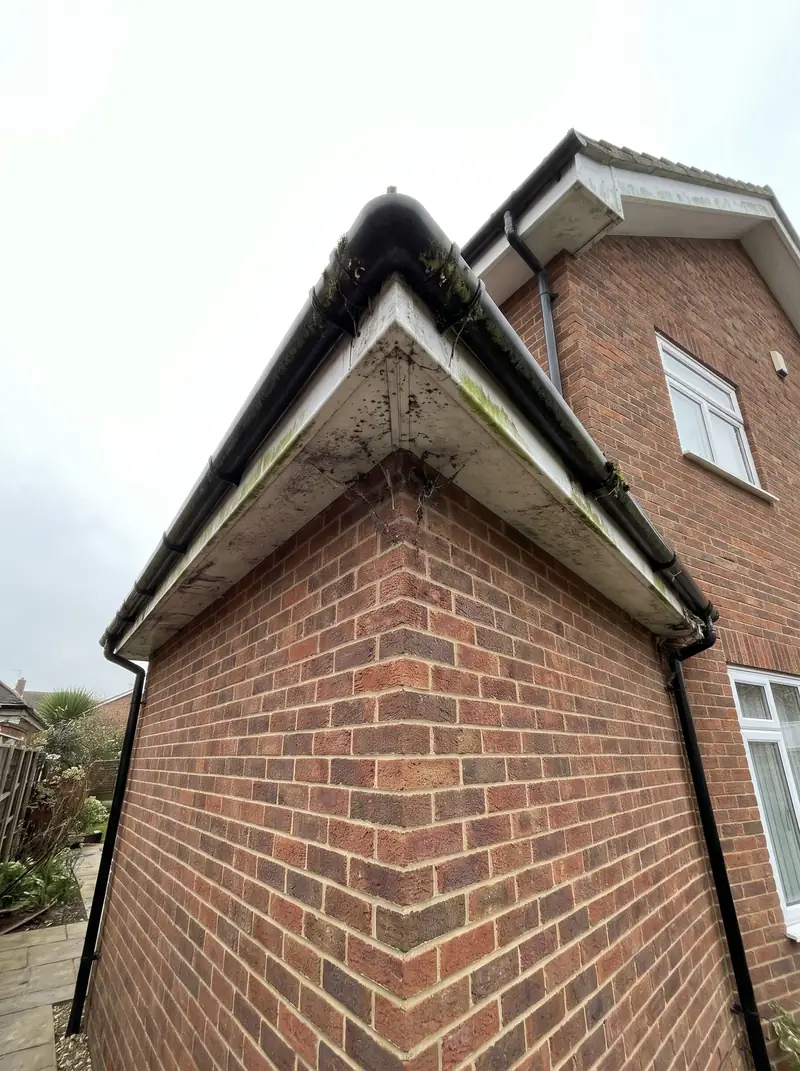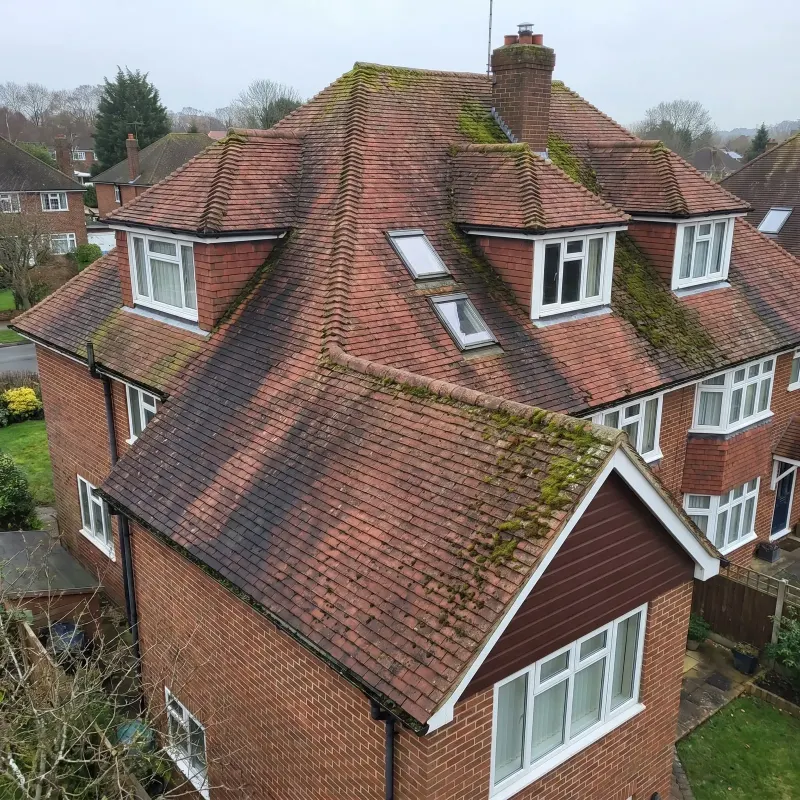
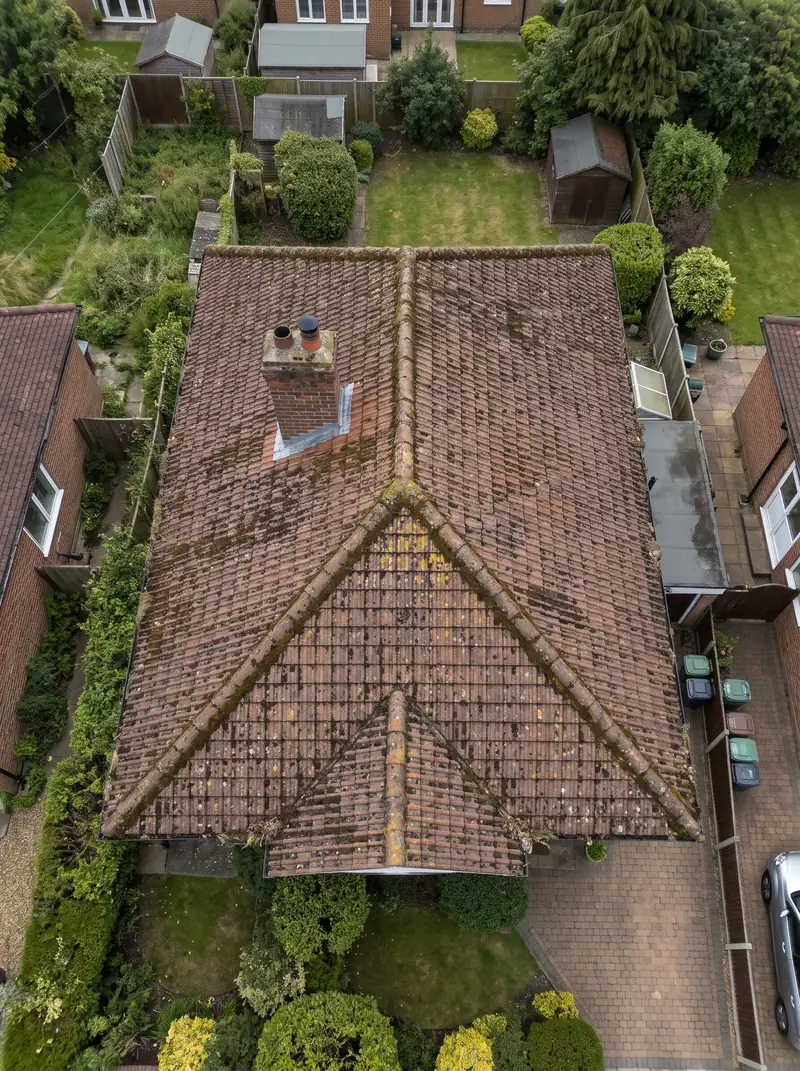
Most moss in gutters grows on the roof first. As cushions of moss dry in warm or windy weather, they break away and slide into the gutter, where they soak up water and bind with grit into a dense mat. Clearing the gutter removes it; treating or cleaning the roof is what slows it coming back.
In this guide
Why does moss end up in the gutter?
Because it grows on the roof and falls off. Moss on tiles dries out in sun and wind, loses its grip, and rain washes it down into the gutter.
Moss grows best on surfaces that stay damp and shaded: the side of the roof facing away from the sun, slopes under trees, and rough concrete tiles. A roof can be green for years and send a steady supply of moss into the gutters below, especially after a dry spell followed by heavy rain.
You can often see it on the ground too: clumps of moss on the drive or patio under the eaves are pieces that missed the gutter.
Why is moss so good at blocking gutters?
It holds water like a sponge and traps grit from the roof. Together they form a heavy, compact layer that slows water and gives seedlings somewhere to root.
Leaves on their own often wash along a clear gutter. Moss doesn’t. It sits in the bottom, swells when wet, and catches the fine grit that washes off concrete tiles. Over a season or two the gutter fills with what looks like soil. Moss lumps also lodge in outlets and the tops of downpipes, which is why moss-heavy roofs often come with blocked downpipes.
Can moss grow in the gutter itself?
Yes. Once there is enough silt and moisture, moss and small plants grow directly in the gutter.
A gutter that holds wet debris for long enough becomes a planter. Moss, grass and seedlings grow in it, and their roots bind the silt together so it no longer washes out on its own. At this stage a gutter needs a thorough clear, and sometimes more than one pass with a gutter vacuum or by hand.
Does clearing the gutter fix the moss problem?
It fixes the blockage, not the cause. If the roof is mossy, the gutters will fill again. How quickly depends on how much moss is up there.
If your gutters were cleared last year and are already full of moss again, look up. A roof covered in moss will keep refilling the gutters. That isn’t a reason to leave the gutters, but it is a reason to think about the roof.
Moss on a roof is usually removed by hand and the roof treated with a biocide, rather than pressure washed, which can damage tiles. That is a job for a roof cleaner. We only work in Essex; if you are in Gloucestershire, Gloucestershire Roof Cleaning cleans roofs there.
Should I scrape moss off the roof myself?
We wouldn’t. Working on a roof is high-risk work, and scraping or pressure washing can damage tiles and push debris straight into the gutters.
The ladder safety guidance written with the Health and Safety Executive treats ladders as suitable for low-risk, short-duration tasks. Climbing onto a pitched roof isn’t one. Leave roof work to people with the right access equipment. From the ground you can still keep an eye on how much moss there is, and get the gutters cleared at the right time of year.
When is moss worst in gutters?
Often after a dry spell. Moss dries, shrinks and breaks away, and the next heavy rain washes it into the gutter.
Many people notice moss on the drive in late spring and summer, after warm, dry weeks. Autumn leaves then land on top of it. That combination is why an autumn clear catches most of a year’s debris. See the best time of year to clean gutters.
Which roofs send the most moss into the gutters?
Roofs that stay damp and shaded: north-facing slopes, roofs under or near trees, and rough concrete tiles, which hold moisture and give moss an easy grip.
Smooth slate and clay tiles tend to hold less moss than rough concrete tiles, although any roof can grow it in the right conditions. Low-pitched roofs and extensions, which drain more slowly, can also be mossier than the main roof. If one side of your house is much greener than the other, expect the gutter on that side to fill faster.
Trees make it worse twice over. They shade the roof, so moss grows, and they drop leaves, which land on the moss in the gutter and bind into a thicker mat. On homes like this, gutters often need clearing more than once a year. See how often gutters should be cleaned.
Key points
- Most gutter moss grows on the roof and falls in.
- Moss soaks up water and traps grit, so it blocks gutters and outlets fast.
- Clearing the gutter fixes the blockage; dealing with the roof slows it coming back.
- Don’t climb on the roof to scrape moss off.
Quick questions
Will a gutter guard stop moss?
Moss lumps tend to sit on top of guards and can still block them. Guards are better at keeping out large leaves than moss and grit.
Is moss in gutters harmful to the house?
Only because it blocks them. The harm comes from the overflowing water, not the moss itself.
Can I put the moss from my gutters in the garden bin?
Usually, yes. Gutter debris is mostly moss, leaves and grit. Check your council’s rules for garden waste.